Healthcare Analytics Market Snapshot: Market Size, CAGR, and Growth Outlook (2021 to 2034)
The global Healthcare Analytics Market size is forecast to increase from $60.49 Billion in 2026 to $351.42 Billion in 2034 at a CAGR of 24.6% between 2026 and 2034.
The Healthcare Analytics market report provides detailed analysis and outlook of Healthcare Analytics segments including By Component (Software, Hardware, Services), By Deployment (On-premises, Cloud-based), By Application (Descriptive Analytics, Diagnostic Analytics, Predictive Analytics, Prescriptive Analytics), By End User (Healthcare Providers, Healthcare Payers, Pharmaceutical & Biotechnology Companies, Academic & Research Institutes) across global and regional markets. Further, analysis and outlook across 21 countries in North America, Europe, Asia Pacific, Middle East, Africa, and South America are provided in the study.
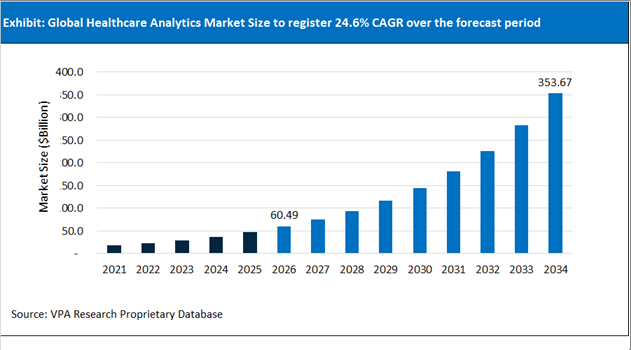
Healthcare Analytics Industry Overview
Artificial Intelligence Accelerates the Evolution of Healthcare Analytics
The healthcare analytics industry is undergoing rapid transformation as healthcare organizations increasingly adopt artificial intelligence, predictive analytics, clinical decision support systems, and data-driven care management solutions. The growing need to improve operational efficiency, reduce administrative burdens, enhance patient outcomes, and optimize resource utilization is driving demand for advanced healthcare analytics platforms. Providers, payers, healthcare technology companies, and government agencies are leveraging data analytics to support evidence-based decision-making and deliver more personalized healthcare experiences.
AI-Powered Clinical Documentation Enhances Provider Efficiency
One of the most significant trends in healthcare analytics is the integration of artificial intelligence into clinical workflows. Healthtech companies are deploying AI-driven documentation solutions that automate administrative tasks and improve clinician productivity. For example, Regard’s integration with Microsoft Dragon Copilot enables healthcare professionals to combine captured clinical conversations with patient health record data, automatically generating documentation while surfacing actionable clinical insights. These advancements help reduce documentation workload, minimize clinician burnout, and improve the quality and consistency of healthcare records.
National AI Strategies Strengthen Healthcare Data Infrastructure
Government initiatives are playing an increasingly important role in shaping the future of healthcare analytics. The Indian Ministry of Health and Family Welfare introduced the Strategy for AI in Healthcare for India (SAHI), providing a comprehensive roadmap for the responsible implementation of artificial intelligence across healthcare systems. The framework emphasizes the development of robust healthcare data infrastructure, ethical governance practices, workforce preparedness, and secure data utilization. Such policy initiatives are expected to accelerate digital transformation and encourage broader adoption of healthcare analytics technologies across public and private healthcare environments.
Analytics Platforms Expand into Personalized Patient Care
The role of healthcare analytics is expanding beyond traditional administrative and operational functions toward direct patient engagement and personalized care delivery. Companies such as Maven Clinic are broadening their virtual care offerings by incorporating analytics-driven patient navigation and individualized healthcare support services. This shift reflects increasing demand for real-time insights that improve care coordination, patient adherence, treatment planning, and health outcomes. As healthcare organizations continue to embrace value-based care models, advanced analytics platforms are becoming essential tools for delivering personalized, data-informed healthcare experiences.
Healthcare Analytics Market Trends, Growth Drivers, Competitive Landscape, and Future Opportunities
The global Healthcare Analytics market is witnessing increasing investments in innovation, product development, digital transformation, artificial intelligence integration, healthcare infrastructure expansion, and strategic partnerships across developed and emerging economies. Key Companies in the industry include- IBM Corporation, Oracle Health (Cerner), Optum, Inc. (UnitedHealth Group), SAS Institute Inc., McKesson Corporation, IQVIA Holdings Inc., Epic Systems Corporation, Microsoft Corporation (Nuance), Inovalon, Arcadia. The Healthcare Analytics market is expected to remain one of the most closely watched segments in the global healthcare industry, with companies focusing on niche market segments. As healthcare systems across the US, Europe, Asia-Pacific, Latin America, and Middle East & Africa continue to prioritize efficiency, access, and innovation, the Healthcare Analytics industry outlook remains shaped by rising healthcare expenditure, demographic change, digital transformation, and product innovation.
The report provides detailed market analysis including-
-
Growth Healthcare Analytics Market size outlook across 3 scenarios- High growth, reference, and Low growth cases
-
Market Trends, Drivers, Potential Opportunities, and Challenges faced by Healthcare Analytics companies
-
Porter’s Five forces analysis- Bargaining power of buyers and sellers, Threat of Substitutes and new entrants, and Intensity of competitive rivalry
-
Detailed SWOT Analysis of global and regional Healthcare Analytics markets
-
Competitive analysis including business description, product analysis, and financial profiles
-
Key country specific analysis detailing key factors shaping the short-term and long-term outlook
-
Recent industry developments and news including mergers, acquisitions, product launches, expansions, and company announcements
Healthcare Analytics Market Competitive Benchmarking and Company Analysis
Leading companies in Healthcare Analytics industry include- IBM Corporation, Oracle Health (Cerner), Optum, Inc. (UnitedHealth Group), SAS Institute Inc., McKesson Corporation, IQVIA Holdings Inc., Epic Systems Corporation, Microsoft Corporation (Nuance), Inovalon, Arcadia. The Healthcare Analytics market remains moderately to highly fragmented, with competition expected to intensify as companies accelerate investments in innovation, geographic expansion, strategic partnerships, and portfolio diversification through 2034. In developed markets such as the United States, Germany, France, the United Kingdom, and Canada, competition is increasingly centered on innovation, reimbursement positioning, and value-based healthcare solutions. Meanwhile, emerging markets including China, India, Brazil, and countries across the Middle East and Africa continue to present significant opportunities for expansion due to rising healthcare expenditure, growing patient populations, and increasing access to healthcare services.
What to expect in US Healthcare Analytics Markets in 2026 and beyond- Market Size, Share, Growth Rate, and Forecast to 2034
The US healthcare expenditure is forecast to reach $8.2 Trillion in 2034 from $5.5 Trillion in 2026 based on the National Health Expenditure Accounts (NHEA) data. With an aging population, rising chronic disease burden, and increasing migration toward minimally invasive and outpatient care, the Healthcare Analytics market remains one of the strongest-performing segments in the country.
The US Healthcare Analytics Companies are opting new business models, optimized pricing models, industry partnerships, and AI-enabled back end transformations to enhance efficiency and cost management. The US Healthcare Analytics market faces successive waves of challenging trends, with strong opportunities across select segments. The CMS plan to implement Medicaid from 2027 is driving states to build eligibility verification systems throughout 2026. Looking ahead to 2034, we anticipate stronger results underpinned by opportunities exist across Healthcare Analytics industry. On the medical device front, over 7,000 device manufacturers continue to gain from increasing demand from demand for implantable devices, surgical instruments, monitoring equipment, and diagnostic systems.
Canada- Proximity to the US and healthcare similarities to EU5 countries fuel sales of Canadian Healthcare Analytics markets
Canada's strong Healthcare Analytics sales performance is underpinned by an aging population and a well-developed healthcare infrastructure. Steady growth in new brand spending in rural and urban locations fuel the long-term prospects of small and medium-sized enterprises across medical, diagnostic, and therapeutic devices. The Canadian Healthcare Analytics market presents significant opportunities for U.S. exporters of medical devices, with the U.S. being Canada’s largest trading partner for this sector. Potential advantages including specialized materials, advanced manufacturing techniques, and digital technologies support the launch of new products in the country.
Germany Healthcare Analytics Trends and Perspectives to 2034- Financial sustainability, hospital restructuring, demographic pressures, and digitization of care delivery continue to shape the German healthcare industry.
Germany continues to remain the largest Healthcare Analytics market in Europe, driven by over €600 Billion healthcare expenditure, €12 Billion medical device R&D expenditure, statutory health insurance system covering 90% German population, nationwide rollout of the electronic patient record (ePA), and large-volume of Healthcare Analytics population. In particular, Research and development in Germany fuels the commercialization of cutting-edge technologies. Companies across the Germany Healthcare Analytics industry value chain are focusing on both domestic markets and exports. The country is also driving digital adoption with the Hospital Future Act driving hospitals to upgrade their information systems by 2027. Over the forecast period, aging population, rising healthcare costs, and increasing procedural volumes drive the Healthcare Analytics market outlook.
France Market Size, Growth Rate, and Forecast Analysis to 2034- Universal healthcare system, high public healthcare expenditure, and strong government support Healthcare Analytics sales through 2034
France Healthcare Analytics companies are emphasizing on opportunities for rapid, at-scale innovation to boost profitability over the long-term. The country’s National Health Insurance spending target (ONDAM) estimates 3.7% growth in the country’s healthcare expenditure. Over the forecast period, expenditure control measures, chronic disease management initiatives, workforce reforms, and efforts to improve system efficiency drive the long-term prospects.
The biggest 2026 policy frame is the PLFSS 2026. The law sets the Maladie branch spending target at €271.4 billion for 2026 and fixes the ONDAM at €117.5 billion for city care, €112.8 billion for health establishments, and €18.3 billion for elderly-care establishments and services. France’s market is also being pulled by demographics. INSEE estimates that on 1 January 2026 France had 69.1 million inhabitants, with 22% aged 65 or over. INSEE also reported that 2025 births were 645,000 and deaths were 651,000, producing a negative natural balance of about 6,000 for the first time since the end of the Second World War.
UK Healthcare Analytics Market Size, Share, and Growth Projections to 2034- Rapid growth driven by new and existing brands across the industry value chain
Small high-need consumer segments remain key priority of Healthcare Analytics distributors in the UK industry. Continuous launch of new products coupled with high expenditures support the market outlook. The UK Government financing remains the dominant funding source at 81.3% of total healthcare expenditure, or £280 billion in 2025. According to the ONS, total healthcare spending grew 7.7% nominally and 3.9% in real terms from 2024 to 2025. Similarly, out-of-pocket spending was £49 billion (14.1%) and voluntary health insurance was £9.5 billion (2.8%). The market is driven by rapid digital adoption with NHS England’s plan to give more than 500,000 staff access to new AI tools.
China Healthcare Analytics Market Growth Drivers, Revenue Trends, and Forecast- Medical insurance coverage is rapidly expanding over the past few years
China Healthcare Analytics market is undergoing a structural shift from hospital-centric care toward a more integrated system emphasizing primary care, outpatient services, and long-term care. Chinese local players are emerging as a strong pillar of Healthcare Analytics industry, offering opportunities for both competition and partnership. Over the forecast period, new and innovative product launches remain key elements driving market outlook. China's healthcare industry is increasingly centered on expanding healthcare capacity, improving access to advanced treatments, and reducing dependence on imported technologies.
The National Healthcare Security Administration reported that by end-2024, China’s basic medical insurance covered 1.32662 billion people and the coverage rate was 95%. Regional disparities in consumer spending trends continue to become more pronounced in the Chinese Healthcare Analytics industry. Over the forecast period, demand will keep shifting toward geriatrics, chronic disease management, rehabilitation, long-term care, and outpatient care, while pricing pressure will remain intense in drugs and consumables because reimbursement.
India Healthcare Analytics Market Landscape: Current Size and Long-Term Growth Outlook - Increased pricing pressures in US market is encouraging domestic vendors to expand across India
Indian Healthcare Analytics market is witnessing the rapid emergence of an ecosystem that brings together diverse companies across the industry value chain. Further, large-scale healthcare public and private investments and a steady growth in chronic conditions is driving sales of pharmaceuticals and medical devices. Further, non-retail channel is experiencing volume decrease and patients are migrating to the retail. Indian medical device firms are also combining precision engineering with lower labor costs to make world-class diagnostics, robotics, and critical care devices.
Brazil Healthcare Analytics market remains price-driven, with products domestically manufactured and accessibility offering potential opportunities
Healthcare expenditure in Brazil exceeds 10% of GDP, with the country among the highest healthcare spenders in Latin America. ANS reported 53.2 million medical-plan beneficiaries in December 2025, while IBGE projects a steady rise in older-age cohorts, with people aged 60+ already representing about 23% of the population. The price sensitive market access is broad through the public system, private coverage adds a sizeable premium layer, and reimbursement, procurement, and hospital efficiency remain key buying drivers.
Middle East and Africa Healthcare Analytics Industry Trends and Perspectives to 2034
According to the World Bank, the Middle East and North Africa population exceeds 500 million, while Sub-Saharan Africa's population exceeds 1.2 billion, making the broader MEA region one of the fastest-growing healthcare demand centers globally. The GCC countries including Saudi Arabia, United Arab Emirates, Qatar, and Kuwait continue to account for a disproportionately large share of regional healthcare spending. Government-led programs such as Saudi Arabia's Vision 2030 are accelerating investments in hospital infrastructure, private-sector participation, medical technology adoption, and healthcare digitalization. On the other hand, South Africa, Egypt, Nigeria, and Kenya remain key healthcare markets due to their large populations, expanding private healthcare sectors, and growing investments in healthcare delivery systems.
Healthcare Analytics Market Segmentation
By Component
Software
Hardware
Services
By Deployment
On-premises
Cloud-based
By Application
Descriptive Analytics
Diagnostic Analytics
Predictive Analytics
Prescriptive Analytics
By End User
Healthcare Providers
Healthcare Payers
Pharmaceutical & Biotechnology Companies
Academic & Research Institutes
Top Companies in Healthcare Analytics Industry
IBM Corporation
Oracle Health (Cerner)
Optum, Inc. (UnitedHealth Group)
SAS Institute Inc.
McKesson Corporation
IQVIA Holdings Inc.
Epic Systems Corporation
Microsoft Corporation (Nuance)
Inovalon
Arcadia
Countries Included
-
North America- US, Canada, Mexico
-
Europe- Germany, France, UK, Spain, Italy, Nordics, Others
-
Asia Pacific- China, India, Japan, South Korea, Australia, Southeast Asia, Others
-
Latin America- Brazil, Argentina, Others
-
Middle East and Africa- Saudi Arabia, UAE, Other Middle East, South Africa, Other Africa
By Component
Software
Hardware
Services
By Deployment
On-premises
Cloud-based
By Application
Descriptive Analytics
Diagnostic Analytics
Predictive Analytics
Prescriptive Analytics
By End User
Healthcare Providers
Healthcare Payers
Pharmaceutical & Biotechnology Companies
Academic & Research Institutes